
Stretch Tent vs Marquee — Which Is Right for Your Event?

If you're planning an outdoor event and weighing up your options, the stretch tent vs marquee question comes up early. Both provide cover for outdoor gatherings, but they're quite different products that suit different occasions, aesthetics and budgets. This guide breaks down the key differences honestly so you can make the right call for your event.
What Is a Stretch Tent?
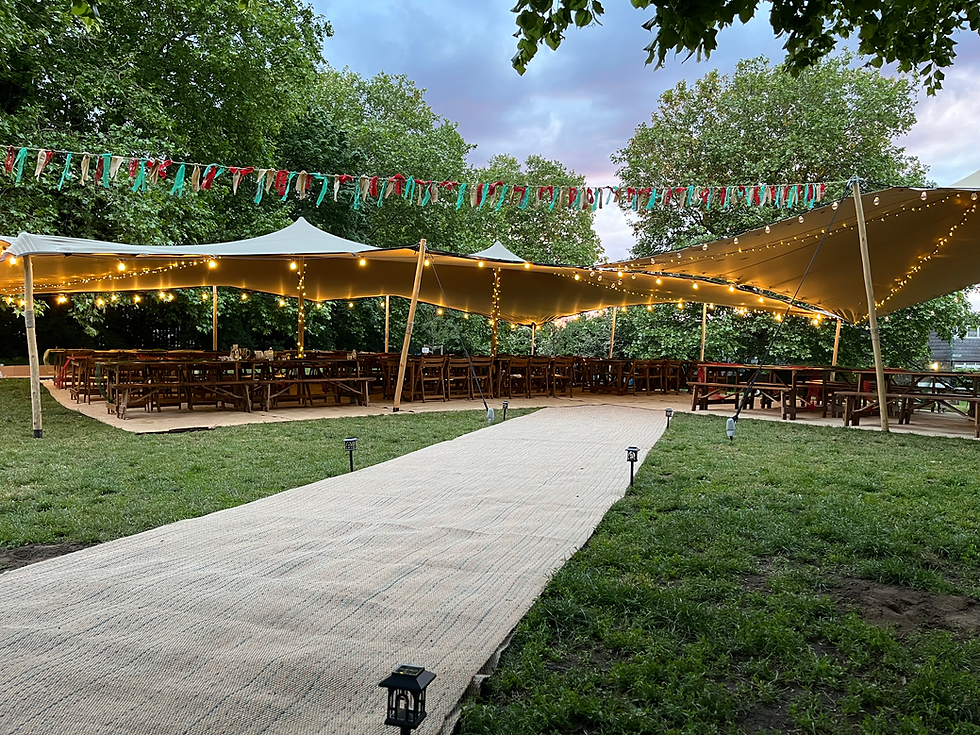
Stretch tents originated in South Africa and are made from a strong, highly flexible waterproof fabric that can be rigged in multiple configurations. Unlike rigid structures, the fabric is tensioned between poles and anchor points to create a freeform canopy that shapes itself to the space rather than imposing a fixed footprint on it.
The result is a structure that feels open, modern and visually striking — very different from the boxy, functional appearance of a traditional frame marquee.
Key characteristics of stretch tents:
Freeform shape — no rigid frame, adapts to irregular spaces, slopes and gardens
Open sides by default — can be partially or fully enclosed depending on configuration
Weatherproof — the fabric handles rain well and the tensioned structure performs in wind
Visually distinctive — the organic shape photographs well and creates atmosphere
Faster installation — typically set up in a day rather than multiple days
What is a marquee?
A marquee is a temporary structure built around a rigid aluminium or steel frame, with walls, a fixed roof and typically a solid floor. It functions essentially as a temporary room outdoors — fully enclosed, weatherproof and structurally independent of the surrounding environment.
Key characteristics of marquees:
Fixed rectangular footprint — requires flat, accessible ground
Fully enclosed — better for colder months or formal events requiring complete enclosure
Internal lining available — can be dressed to feel more permanent and formal
Longer installation — typically requires 2-3 days to erect properly
Higher cost — the additional infrastructure of frame, flooring and lining pushes costs up significantly for larger setups

Stretch tent vs marquee — the honest comparison
Stretch tent | Marquee | |
Aesthetic | Modern, organic, distinctive | Traditional, formal, classic |
Space flexibility | High — works on irregular ground | Low — needs flat, clear ground |
Enclosure | Open by default, partially closeable | Fully enclosed |
Installation time | 1 day typically | 2-3 days typically |
Cost | Lower for equivalent coverage | Higher, especially at scale |
Best season | Spring to autumn | Year-round |
Photography | Excellent | Good |
When a stretch tent is the better choice
A stretch tent works best for events where the setting and atmosphere matter as much as the practical shelter. Garden parties, weddings, birthdays and festivals are all occasions where the visual impact of the structure contributes to the experience rather than just being functional background.
If your venue has character — a garden with mature trees, an uneven field, a courtyard with surrounding walls — a stretch tent will work with those features rather than fighting against them. And if photography matters, the organic lines and natural light that comes through an open-sided stretch tent consistently produces better event photos than the interior of an enclosed marquee.
For events between May and September across London and the South East, a stretch tent also tends to be the more cost-effective and visually striking choice.
When a marquee might make more sense
A marquee makes more sense when full enclosure is genuinely required — typically for winter events, formal corporate dinners where a completely contained environment is expected, or very large scale events (250+ guests) where the sheer volume of people requires the structural capacity of a frame marquee.
If you're hosting in October through March and full weatherproofing and heating containment are priorities, a marquee's enclosed design does that job more effectively.

The cost difference
For most private events in the 25-130 guest range, stretch tent hire is meaningfully cheaper than an equivalent marquee setup. A marquee at this scale requires frame, flooring, lining, walls and a longer installation period — costs that add up quickly. A stretch tent hire includes the structure, professional installation and breakdown, and can be accessorised with lighting, matting and furniture from the same supplier.
For a guide to stretch tent hire costs across London and the South East, including specific pricing by tent size, see our pricing guide.
Still not sure?
If you're weighing up options for a specific event, get in touch with your guest count, venue details and event date. We're happy to give you an honest recommendation — and if a marquee genuinely suits your event better, we'll say so.


Comments